September 15, 2014

Designed in China - Assembled in China

Fueled by WhatsApp peer pressure, our ten-year old recently bought his first smartphone. Make: Huawei. Price: Euro 70.00 without a plan/contract. Performance: admirable. Anyone used to Apple’s macrocosm will find it hard to believe that a smartphone can retail at that price. Mobile phones in Europe used to be all about Nokia, Ericsson, Motorola and Siemens. Then came Apple and Samsung. Names disappeared. Now it’s China’s turn in changing the handset game.

A common Western misconception

“Made in Hong Kong” was imprinted on many of the toys in my boyhood days (way back in the seventies). Then this label was synonymous with “cheap”, “plastic”, “throw away after light use”. At that time China meant little more to me than the occasional meal at a restaurant, the timeless wisdom of a nation as portrayed in the sayings of Confucius, or the iron-fisted communism and class struggle headed by Chairman Mao. Quite frankly, today China is much more than world’s manufacturing workbench. It’s well on its way in advancing to a major R&D force whose impact is beginning to be felt by high-tech consumers around the world. Are the days of “Designed in California - Assembled in China” numbered?

China: think big, think volume

When a topic touches something as vast and far away as China, it’s tough staying grounded and getting the facts right. Clearly China not only has the brains, capability and drive to impact technology worldwide. More than that it has an immense end-user base at home that allows scaling volume production into realms unthinkable for many of us in the West. Case in point: China Mobile boasts some 750 million subscribers. That’s on par with the total population of Europe! Imagine, one single wireless operator with this sheer number of customers at the controls of mobile voice, messaging, apps, handsets and other desirable services.

ZTE, OPPO, Lenovo, Xiaomi, Meizu, Huawei, HTC, Jiayu

Reaching out and moving in

On the infrastructure side Chinese companies like Huawei and ZTE have already made inroads in foreign markets. I remember their sleek offices quietly opening in Dusseldorf on the river Rhine several years ago. Price disruptions in telecoms infrastructure followed and ever since Alcatel-Lucent, Ericsson and NSN (Nokia Solutions & Networks, formerly known as Nokia-Siemens Networks) have been feeling the bite at their established clientele. Yet it’s not all threat. Flip the coin and China’s colossal market offers tremendous trade opportunities for foreign companies.

Telecoms market research on China

In wi360’s research and event directory you will find many studies from various sources that provide a detailed view of China’s mobile and wireless landscape. Here are a few sample results when entering “China” in the Search field for Reports at wi360 .
  • China Telecommunications Report from Business Monitor International provides an overview of the Chinese telecoms market. In addition it profiles 19 MVNOs (mobile virtual network operators) in the country.
  • China’s top five vendors account for 20% of the world’s smartphone shipments from Canalys ranks smartphone vendor shipments and growth in China’s domestic and foreign markets
  • The Mobile Industry Alliance’s (MEA) Certimo benchmark measures user experience ratings for popular Android smartphones sold in China from manufacturers such as HTC, Huawei, Lenovo, LG, Meizu, OPPO, Samsung, Sony, Vivo, Xiaomi and ZTE, and these have been published by Tencent, China’s largest Internet portal. Results can also be found on MEA’s website.
  • Consumer Demand Analysis of Smart Wearable Devices in China is a survey from MIC - Market Intelligence & Consulting Institute in which Chinese consumer purchasing behaviour with respect to wearables is profiled
  • TD-LTE Market Developments and Forecast, 2014–2016 from Digitimes details mobile networks based on China’s homegrown TD-LTE standard and their outlook in 17 further countries where they have been deployed
  • Strategy Analytics’ report titled China Mobile’s One Man Show to End reveals the strategies of China’s three operators regarding LTE FDD (note: not TD LTE) infrastructure in the country
  • Global and China EMS and ODM Industry Report, 2013–2014 from ResearchInChina takes stock of manufacturing services for consumer electronics in China, Taiwan and other countries around the world

Understanding China and its wireless markets as well as the companies, services and products that comprise it mobile ecosystem is an important step in spotting and tapping potential opportunities and participating in the country’s unquestionable growth in trade. Western manufacturers may even be at an advantage in being able to produce high-quality kit at much lower production volumes that allow product customisation and variation. “Designed in California - Assembled in California” could potentially be a prized imprint from the perspective of future Chinese consumers.

July 4, 2014

Spectrum - private or public beachfronts?


Spectrum seems similar to real estate. At least that's the image that is conjured up by the often used analogy "public or private beachfront?".

You could argue the beach (spectrum) belongs to government (regulator) who should plan its best use for its people, either by selling it off (licensed spectrum) to an investor (carrier) with strict clauses for its development (cellular infrastructure coverage) and ensuing use by paying visitors (subscribers), or by keeping it a public space open and free to all (unlicensed spectrum). This seems like a pretty good analogy but it seems to ignore one key contributor that is throwing a spanner in the works: technology advancement, or more accurately, semiconductor improvements. Wireless data is exploding through the usage of new wireless handhelds and devices and there is no end in sight. The Internet-of-Things is looming, further intensifying the situation as seers predict everything with a current running through might potentially be a source of further wireless data. So all sights are set on "spectrum" to offer a cure, and governments (regulators) who ultimately own it. Indeed, we need more spectrum. And lots of it.


Spectrum is big money

Spectrum is where big money meets legislation meets high-tech, yet always bound to the perennial laws of physics. It's a billion-dollar industry that encompasses auctioning, immense investments for operators who build nation-wide networks, influenced by a constant stream of new technologies that improve connectivity for all. Proponents of the one camp (licensed) rightfully argue that the immense investments for carriers building nation-wide networks require long-term perspectives for ensuring a profitable business. The other side (unlicensed) maintain that only open policies guarantee fair and efficient use of the airwaves and lead to universal, affordable and ubiquitous broadband for all. A case of "Cellular" vs. "WiFi" is in the ring for the next round.


"Spectrum Crunch" - a myth?

The crux of the issue is that much of our spectrum, particularly around the "sweet spot" is already in use. At least that what the skeptics purport, creating a shortage or "spectrum crunch" myth. The truth is a little more varied and subtle though.


Spectrum's Sweet Spot
Click to enlarge


Radio spectrum extends for 3 kHz to 300 GHz and mobile phones currently operate between 700 MHz to 2.6 GHz in this range - the so-called "sweet spot" based on state-of-the-art technology. Note, that this sweet-spot spectrum block represents roughly just under 1 % of available "radio spectrum". Spectrum shortage? Well, yes, in a way, if  you regard what's exploitable using today's available technology. Just as broadcast AM radio in the early decades of the last century relied on valves and tubes for frequencies up to 15 kHz, today's semiconductor technology defines wireless communications around the 1 GHz mark. But what about tomorrow? 


First approach: making the best of "redundant" spectrum

To date specific blocks in the full radio spectrum range have been allocated for specific purposes or services by governments, and most of these are historical in context. For example blocks for maritime navigation, aeronautical navigation, public safety, broadcast TV etc. A true patchwork as can be seen in Sebastian Anthony's "wireless crunch" blog for ExtremeTech. Of course spectrum is a unique and therefore valuable resource, but it does differ from oil, gas, minerals etc. which face continuous depletion until none are left. Spectrum can be revitalized by closing older, inefficient services, as has or is being done for analog TV, or by making use of "white space" consisting either of unused spectrum blocks or guard bands between used blocks/frequencies that were required in prior times for broadcast and communications technology to work.


Technology advancements increase spectrum usage

As the needle of technology heads towards the future, better usage in existing spectrum blocks and new usage in regions higher on the spectrum map become available accordingly. Ever decreasing semiconductor process nodes ensure the implementation of mathematical algorithms providing better modulation techniques and other advancements that ultimately increase bandwidth and bit rate per Hertz of frequency. Of course at the heart of cellular and wireless communications is the trade-off in providing the best capacity (more bandwidth/higher bit rates using higher frequencies) for the largest possible coverage area (lower frequencies are better here). Broadly speaking, lower frequencies travel further than higher ones but cannot carry as much information. The current sweet spot for wireless communications is determined by these facts and primarily governed by what's technically possible based on state-of-the-art semiconductors. Advances in semiconductor technology will allow the sweet spot to travel further up the spectrum over time and provide better bandwidth. The diagram below shows how these advancements will ultimately lead to the still amorphous 5G technology as we get closer to the year 2020 where wireless Gigabit speeds will become reality.


Does your devices' antenna size still matter?

Fitting a large antenna or satellite dish on your roof works for great TV reception, but what about handheld/portable wireless communication devices? One of the limiting factors of wireless devices has always been the required size of the antenna for transmission and reception. Antennas "resonate" at one quarter of a frequency's wavelength. Taking this factor into account for the typical current "sweet spot" frequency at 1 GHz leads to a minimum necessary antenna size of 7.5 cm which resembles an acceptable cell phone size. At 300 MHz this increases to 25 cm whereas at 3 GHz we get down to 2.5 cm. In other words, higher frequencies spell out smaller device form factors, or more room for integrating antenna arrays, read MIMO et al. As these new antenna technologies come into play, data rates can be increased through better wireless performance in several respects, irrespective of the maximum bit rate achievable by the modem dictated by modulation techniques/Shannon's theorem.


Some worthwhile spectrum vs. technology resources

Spectrum, it's allocation, management and better exploitation through technology is a complex field in itself. Both free and subscription-based resources provide great insight into the issues at hand. Regarding today's 4G technology, we've reached the max in terms of squeezing as many bits as possible per Hertz of spectrum, as eloquently reported by Kevin Fitchard at Gigaom on wireless networks as workhorses of the web. A further great reference is Frank Rayal's blog looking at the capacity-coverage issue for licensed and non-licensed band. It investigates and compares differences in this respect for LTE and WiFi, both using a 20 MHz band. Certainly both camps have convincing points to advocate as we move further down the timeline. Telecoms and spectrum expert Gunjan Idrayan writes a regular insightful blog on spectrum and wireless with a particular focus on the situation in the United States and India. You'll also find some timeless articles about licensed and unlicensed spectrum as well as mobile broadband written by Peter Rysavy. Furthermore here's a short list of paid research that is well worth investigating if spectrum belongs to the core of your professional work.


The Global Spectrum Database
PolicyTracker
Spectrum Auction Tracker
Analysys Mason
2G, 3G, & 4G Mobile Network Subscriptions, Spectrum Licensing, Ownership, Infrastructure Contracts & Handset Shipments Database
Signals and Systems Telecom


Spectrum for Mobile Broadband
IDATE
Radio Spectrum Intelligence
Tolaga Research

There are many more market research reports on the topic of spectrum available, and you can also stay on top of the latest worldwide events by signing up at wi360 (free). You will receive email alerts on new research and events regarding the specific topic of spectrum.

Spectrum's future

Governments that regulate spectrum and the technology sector that provides the devices for wireless access are both doing their best by squeezing the most out of a limited resource. Yet each of them works with a completely different heartbeat and thus the "divide" is increasing at an alarming level to the detriment of the consumer and subscriber. Wi-Fi over the past decade is a case in point how unlicensed spectrum has been addressed remarkably well at breakneck speed outside of government intervention. At the same time, network investments in the licensed spectrum must also remain a lucrative business for carriers. With the subscriber in mind, the golden age of raking in exorbitant cash amounts by governments through spectrum auctioning requires a future rethink.

Our spectrum future will be mapped out how well concepts from all parties will be mutually respected and implemented.

April 30, 2014

Supercharging Cellular Networks

Smartphones are great - next to that essential phone call, they give us email and Internet access on the go, updates on friends through social media, help in finding the way to a new restaurant, and a plethora of other useful features. On the other side, they give operators the challenge and headache of how to solve congestion on their cellular networks. Apple's first iPhone, its touchscreen, its app concept, marked an iconic game change in the industry, not only for the user, but even more so for cellular infrastructure. Its introduction opened the sluice gates for mobile data demand, and ever since the need for more bandwidth on networks continues to surge.


Small cells: from micro to femto

Not only do small cells offer operators a way out of the data crunch dilemma, but they also improve call reliability and quality indoors where mobile connections often fall victim to weak reception.
Femtocells surfaced first, as far as I can recall,  and they were toted as technology to storm consumer's homes for solving weak indoor signals. Metrocells, considered femtocells with an increased range, followed on. Then microcells and picocells. Nanocells seemed missing on most product roadmaps. In strict math terms, micro is one millionth, nano one billionth, pico is one trillionth, and femto one thousand trillionth. In other words, each metric prefix is one thousandth smaller. This appears to be linked in no way to small cell technology rationale, or their coverage range, and is probably a marketing ploy for naming small, smaller, smaller still... Good thing that these monikers with their differing and overlapping definitions were all placed in the superset "small cells" at some point.


Small Cell Classification
Typical Range
Microcell
2 km
Picocell
200 meters
Femtocell
Several tens of meters
Reference: a base station macrocell has a typical range of ca. 35 km


Many shapes, sizes, scenarios

Essentially small cells provide an opportunity in solving mobile network overloads by adding further access points (read base stations) within the cellular operator's macro network at a higher cell resolution or smaller range. That's a very simplified view.

Small Cells: different formats, different deployments, different approaches
Sagemcom AP2820V
Ericsson’s Dot small cell solution
Ubiquisys' Tecom FC1080 outdoor solution
Residential
Sagemcom AP2820V plugs into an AC socket: 8 calls in parallel, 7.2 Mbps, 30 meter range
Photo courtesy of Vodafone
Enterprise
Ericsson’s “Dot” solution is a radio-only access point connected to an "enterprise base station" and powered by LAN
Photo courtesy of Ericsson
Outdoor Rural
Ubiquisys' Tecom FC1080 outdoor solution with coverage up to 3km – 16 voice calls, 14.4Mbps HSPA
Photo courtesy of Ubiquisys
 
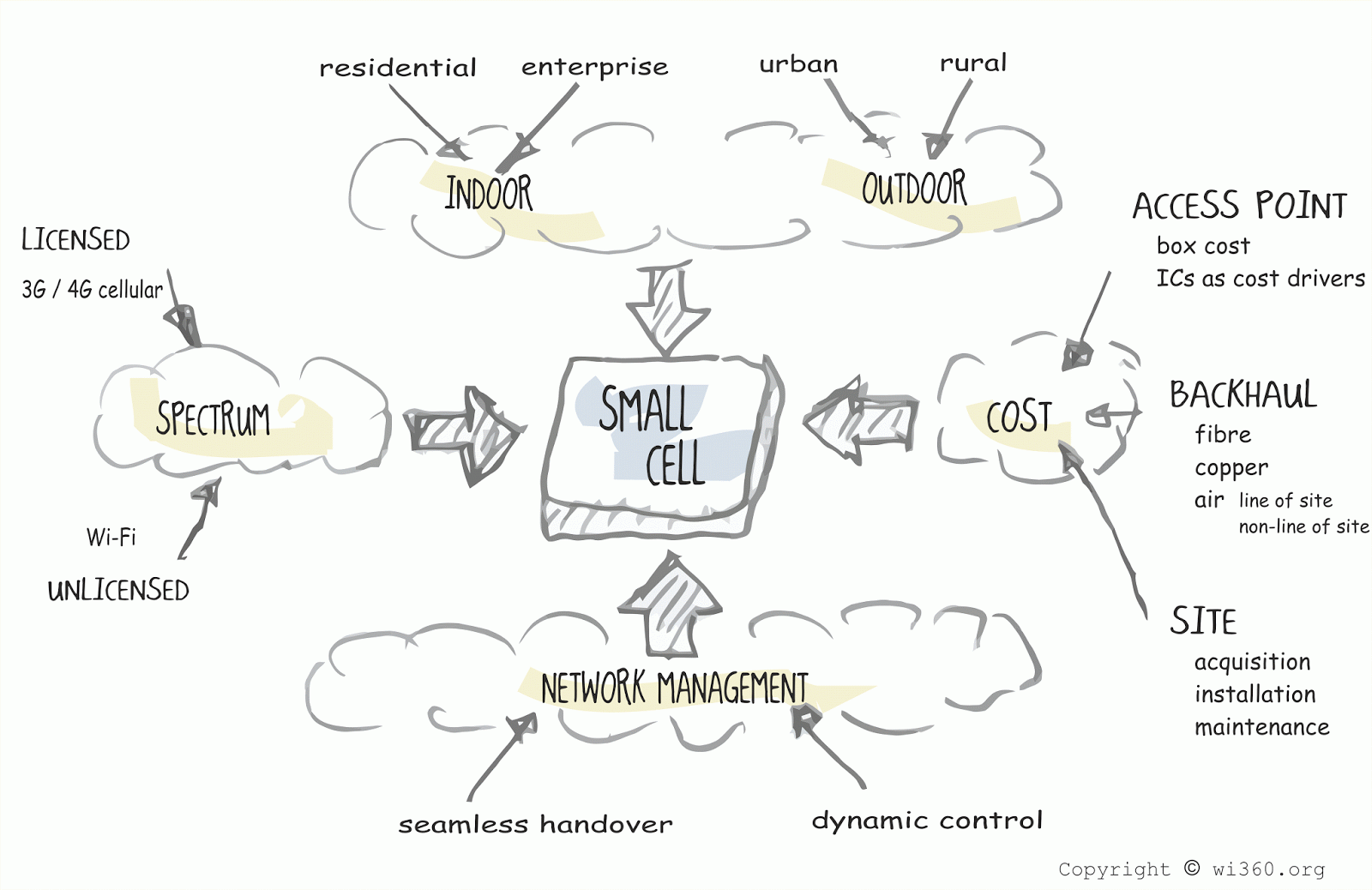
This plain picture becomes more complex when other forces are factored in. Are we dealing with indoor or outdoor coverage? What about using Wi-Fi and public hotspots in the unlicensed spectrum as a cellular network offload? How do you connect these small cells to the operator's existing macro network (backhaul) and best manage and dynamically allocate bandwidth? How to find and deploy new sites for small cells and make sure they provide a profitable perspective?

Small Cells: spectrum, indoor-outdoor deployment, sites, costs and network management
Click to enlarge


Small Cell ForumEach scenario comes with its own set of specific challenges. To further the cause of expediting roll out of small cell technologies, the Small Cell Forum was founded in July 2007 by the companies Airvana, ip.access, NETGEAR, picoChip, RadioFrame, Tatara and Ubiquisys. The group has done some great work to address these challenges by providing concrete return-on-investment and best practices technology guides for residential, enterprise and public scenarios. Notwithstanding, even many years down the road it is evident that the manifold challenges facing small cell deployments are hindering their adoption. Yet time is playing into the hands of this technology as an efficient means of solving the data bottleneck.


Highly-integrated small-cell SoCs bring equipment cost down

Semiconductor vendors such as Cavium, Freescale, Mindspeed and Qualcomm are addressing the nascent market with offerings that combine 3G or 4G (LTE) technology with latest WiFi standards (802.11ac and 802.11n) on a single piece of silicon or system-on-a-chip (SoC). Combined with the a transceiver and power amplifier for the RF section and other ICs for the type of backhaul desired, they deliver a complete base station in a compact, access-point format. A central theme of all such designs is their focus on energy efficiency. As such they employ a number of smart schemes to mimimize energy consumption so that power requirements don't impede the small cell uptake in homes or their placement on so-called street furniture (lamp poles, building walls etc.).

Small cell market research

The market for such equipment will indeed become huge. The research company Infonetics expects a $3.6 billion worldwide spend on small cells during the period 2013 - 2017.
Monica Paolini, founder of Senza Fili Consulting, contends that small cells will need Wi-Fi to succeed, as its uses license-exempt spectrum, a technology that is still not a close chum to many cellular operators. Small cells and their operators will eventually accept the wisdom of utilizing ubiquitous Wi-Fi and find ways to solve the complex interoperation between macrocell, small cell, and Wi-Fi elements to deliver adequate bandwidth and seamless handover whereever one may be. Such solutions are coined as wireless HetNets (heterogenous networks).
Other research outfits such as iGR are acutely aware of the cost of deploying sites that is hindering small cell roll out. Their scenarios breakout the cost in detail based on small cell type, backhaul (fiber or microwave), backhaul speed, labor and installation, power and ancillary equipment expenses.
Analysts at Tolaga Research point out that the industry requires an average $5,000 target site cost for small cells to succeed and the backhaul contribution should constitute no more than 20-30 % of this figure.


Reports galore

There is a lot of market research available that proves the smattering of small cell alternatives available and implementation scenarios.

Over 50 research reports covering Small Cells at http://www.wi360.org/

Small cell events

Equally many events are going to be hosted in 2014 on this subject (see http://www.wi360.org/ too) that keep industry participants in touch with the latest developments in the small cell market.

Ultimately small cells will allow smartphone, tablet and portable computing device owners to stay reliably connected and consume bandwidth no matter where they are or what they do.

March 11, 2014

MWC 2014 - Mobile World Congress Wrap-Up

It feels like the early morning rush of commuters at a train station on a key junction, yet I'm on the upper walkway that connects the 8 pavilions at the new Fira Gran Via expo grounds in Barcelona that is host to the Mobile World Congress. Over 85000 attendees flocked to the annual gathering of the worldwide mobile crowd this year (2014) to see the products and services of more than 1800 exhibitors. Now, a few weeks later, as the dust of announcements, trends and gossip settle, here are some memorable observations from media, analysts and others who visited the show, including myself.

Great expo, but what about the conference?

Those of you who remember the original location of MWC in Cannes (titled 3GSM) or previous versions of the event at Barcelona's Montejuic fairgrounds will miss the distinct charm, the ease of getting there, and strolling around a confusing maze of booths without ever being connected to WiFi. What you now get instead is a long train ride, blisters on your feet from doing the rounds, BUT an admiringly well-organized exhibition. Hats off to GSMA and the venue people! Yet the adjunct conference pales substantially in terms of content. Passes start at €2,000.00 which is asking a lot for a conference agenda that fits on to a few pages and primarily boasts key note speakers of notoriety who are broadcast anyway on the many wall-like screens scattered across the fairgrounds.

Wearables herald a new era for devices

Wearables were this year's big new theme with smart watches and health bracelets everywhere. Will the consumer who is accustomed to never bother about regularly charging "jewellery" accept this new burden every other day?

What’s inside the Sony smart watch?
TechInsights
What’s Inside the Pebble watch?
ABI Research
What’s inside the Nike+ Fuelband SE?
TechInsights


Wireless charging by way of placing a device on a mat or specific surface is breaking through the ice with two consortia proposing different approaches.The Wireless Power Consortium is promoting it's Qi technology based on inductive charging whilst Rezence (formerly A4WP - The Alliance for Wireless Power) believes its magnetic resonance approach is more promising.

The Nokia X was launched at the MWC - notable in that it is a Microsoft device that uses Android instead of Windows' mobile operating system. A difficult balancing act lies ahead for Microsoft, and as Jim McGregor from Tirias Research notes, a clear downside its that it does not offer Google Play store, making the app side on the Nokia X rather unappealing.

Smartphone pricing is spiraling downwards in an attempt to capture lower-income markets segments. Case in point: Mozilla (mobile version of its operating system Firefox) teamed with Spreadtrum (Chinese mobile phone chip maker) to show a WCDMA/EDGE smartphone reference design that is expected to retail at no more than $25.00 owing to the low memory requirements of the browser. We'll have to wait to see if this promise is fulfilled.

Smartphone manufacturers are attempting new, innovative ideas to escape the unimaginative slate-life form factor. LG's new G Flex banana-shaped smartphone sports a large curved display with superior viewing qualities. Retailing at around € 800.00 this is not a smartphone for everyone, but certainly an eye-catcher.
LG's G Flex - Source: http://www.lg.com
Russia's Yota breaks the mold by featuring a second always-on, full-sized e-ink display on the back of its YotaPhone that opens up a set of never-thought-of-before useful features.
The YotaPhone with an always-on full.sized e-ink 2nd display - Source: http://yotaphone.com
Phone sizes are definitely on the increase proving the point that the shift from a device used primarily for voice calls to a browser/emai/messaging/entertainment platform is gaining further foothold. Apple beware! For the uninitiated it is indeed a weird spectacle to see users hold almost tablet-sized devices to their ears for that all important call. 
 

My next smartphone will be a 64-bit one

Ever since Apple introduced its 64-bit A7 application processor in the iPhone 5S, many other vendors have followed suit. The MWC had its fair share of announcements with Intel, Marvell, MediaTek, Nvidia and Qualcomm all announcing 64-bit chips with smartphones using these due towards the end of the year. The questions remains if bringing the performance of servers to mobile devices through a wide-bus architecture may be overkill. But remember, during the nineties many pundits were convinced that 8-bit mobiles would suffice forever. So the story goes on. 


64-bit mobile processors to dominate by 2018
ABI Research
Who needs 64-Bit mobile processors?
EETimes
Cellphone & Tablet Chip Markets
Forward Concepts


Cost cutting in the infrastructure world

Virtualization of functions in the network, particularly on the packet core and transport layer, is on the agenda of most infrastructure vendors as cost cutting goes into its next round. As Caroline Gabriel of Rethink Wireless notes "battle lines are being drawn, and the players are placing big bets on unproven technologies and new architectures." Particularly smaller players are providing new solutions that will drive down costs of the network and they will certainly be the target of acquisitions during the months ahead.
Small Cells that solve the challenge of overcoming the data capacity crunch in urban, enterprise and residential areas with high subscriber densities are now becoming real and entering the deployment stage. Yet overcoming the high cost of backhaul (in relation to the cost of the cell itself) remains an issue, as an Informa analyst notes. In a similar vein, Frank Rayall of Xona Partners reported "Backhaul is the problem!"  last year.

Backhaul is the problem

Machine-to-Machine (M2M) and Internet-of-Things (IoT)

Enabling all electronics and industrial devices with cellular or wireless capabilities is a promising way forward for operator's to expand their revenues outside of their traditional subscriber-based voice & data services. The challenge in the M2M (machine-to-machine) sector remains that every usage scenario is application specific with particular deployment considerations and constraints. This does not scale well and thus monetization remains a formidable challenge for operators. Moving to the home, Glenn Lurie of AT&T envisages that  "anything that has a current going through it" as a potential IoT (Internet-of-Things) device. Stan Boland whose start-up Neul offers complete IoT wireless solutions, including endpoint modules, base stations and management in the cloud, states that "the price of modules needs to drop below $2.00 and they need be protocol-agnostic" for IoT to become a viable option for consumer device and white good integration.

Enterprise Mobility is big

Mobile collaboration and BYOD (Bring Your Own Device) are driving security and cloud services in the enterprise space.  According to Andrew Brown of Strategy Analytics, the global mobile workforce will increase from 1.3 billion this year (2014) to 1.6 billion in 2017 with the Asia-Pacific region being particularly vibrant. No wonder that Enterprise Mobility is a key theme at MWC, taking up increasing exhibition space. I was surprised to see Airwatch (recently acquired by VMware) to have a booth that seemed to be one of the largest at the show despite a worldwide headcount of only 1600.

Enter "The Connected Car"

New to the MWC are exhibitors such as Ford, BMW, and Volvo, and the operator Telefonica showing a Tesla Model S on their booth. The trend "The Connected Car" is more than just about infotainment and navigation inside the car. Automotive manufacturers are testing new waters by embedding modems in the vehicle enabling better management from outside the car, allowing it to become one further item to deliver useful information to its owner's smartphone. It's also all about tightening the bond between vehicle manufacturer and owner through remote diagnostics to the point that tomorrow's car might be viewed as a further asset of an automotive manufacturer's fleet.

OTT - just another acronym but with enormous operator implications

The $19 billion Facebook acquisition of the WhatsApp somewhat eclipsed many other exciting announcements at this year's MWC. That's a formidable valuation for a 5-year old company with just over 55 employees and a product that some view as better SMS messaging for a $1 subscription fee per year. Yet it certainly drives home the point that Over-The-Top (OTT) services such as WhatsApp require priority attention from operators who will certainly see their share of the lucrative $1 billion per year worldwide SMS business shrink as time progresses. 

See you next year

All in all it was time well worth spent in Barcelona despite dizzying overnight costs. Mobile World Congress does really draw the worldwide mobile crowd in every respect.